Polar Animals in English for Kids
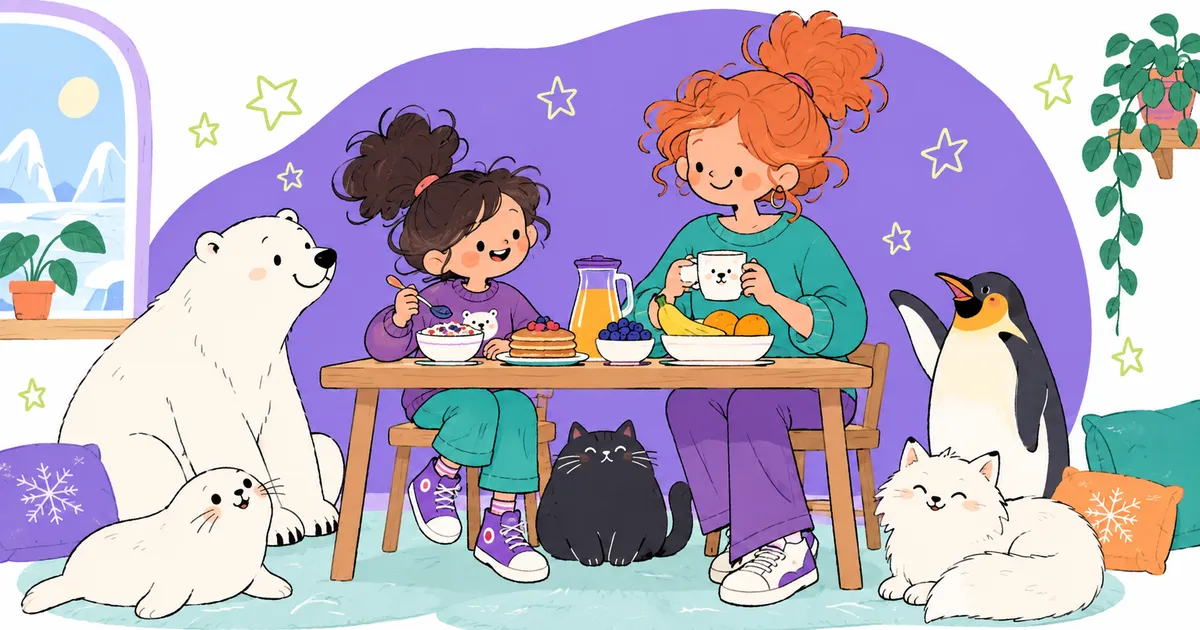
Polar animals live in or visit cold regions around the North Pole, the South Pole, or both. Polar Animals in English: Words and Activities for Kids teaches animal names, body parts, habitats, and sentence patterns. Begin with eight to twelve words, not the full set. Children can sort pictures, act out movements, answer clues, and describe each animal. A map shows that the northern and southern polar regions differ—and that polar bears and penguins never meet in the wild.
Build the Core Word Set
When teaching Polar Animals in English: Words and Activities for Kids, group nouns by region. Regional groups give each word context and prevent geography mistakes. Say each name, show a picture, and have your child repeat a short phrase such as “a walrus” or “the snowy owl.”
Once the names feel familiar, add: fur, feathers, flipper, beak, tusk, whiskers, ice, ocean, and tundra. Teach baby-animal terms too: a young polar bear or fox is a cub, a young seal is a pup, and a young penguin is a chick.
Put the Words into Useful Sentences
Labels alone are not enough. Put each animal name into a reusable pattern: “It is…,” “It has…,” “It can…,” “It cannot…,” or “It lives….” These frames help beginners speak before learning complex grammar.
- It is a snowy owl.
- The walrus has long tusks.
- An orca can swim quickly.
- An emperor penguin cannot fly.
- The narwhal lives in northern polar waters.
- Which animal has black-and-white feathers?
Polar Animals in English: Words and Activities for Kids grows richer when children join ideas with and, but, and because. A younger learner might say, “The seal can swim.” An older learner can expand it: “The seal can swim well because its body is suited to life in water.” Accept short answers before requesting longer ones.
Match Activities to Your Child’s Age
School-age kids: use picture cards, toy animals, and movement. Ask your child to waddle like a penguin, swim like a seal, or spread their arms like an owl. Give one-step instructions: “Touch the walrus” or “Put the polar bear near the ice.” Limit each round to five or six words.
School-age kids: sort animal cards into the North Pole region, the South Pole region, and both regions. Then give three clues: “It is a bird. It has feathers. It cannot fly.” Children can draw an animal and label its beak, fur, flippers, tusks, or tail.
School-age kids: turn Polar Animals in English: Words and Activities for Kids into a research task. Learners compare two animals by habitat, body covering, food, movement, and size without copying sentences. They can present five facts, answer a follow-up question, and name their source.
Practise Little and Often at Home
Use five-minute reviews throughout the week. First, name and point. The next day, hide the labels and ask your child to recall each word. Later, mix old and new cards to build active memory. In multilingual families, compare names briefly, then return to the English word and sentence.
Keep cards near the kitchen table or another familiar place. Ask two questions before meals or bedtime: “Which animal has tusks?” and “Where does the emperor penguin live?” In LearnLink lessons, our tutors can reuse familiar words in questions, descriptions, and conversations.
Five-clue Polar Animal Challenge
Read one clue at a time and let your child answer without seeing the word list. 1. I am a large white bear. 2. I have tusks and whiskers. 3. I am a bird that swims but cannot fly. 4. I have one long tooth that looks like a horn. 5. I am a white owl. Answers: polar bear, walrus, emperor penguin, narwhal, snowy owl.
Fix Common Vocabulary Mistakes
Do not treat the North Pole region and Antarctic as the same place. The far north is the northern polar region; Antarctica surrounds the South Pole. Mark both on a world map to reinforce the polar bear and penguin distinction.
Check word order and plurals. English uses “polar bear,” not “bear polar.” One fox becomes two foxes, while one reindeer can become two reindeer. If your child says “two fox,” reply with “Yes, two foxes” and continue instead of pausing for a long correction.
Translation should not be the only task. A child may know the animal in another language but struggle to retrieve its English name. Combine pictures, sounds, actions, clues, and translation. Model pronunciation and invite another try, but do not label a home accent an error when listeners understand the word.
- Practice five polar animal names with children aged six to nine daily.
- Use picture cards to contrast seal, sea lion, and walrus clearly.
- Ask your child to sort eight animals by northern polar or Antarctic habitat.
- Read one illustrated polar animal book aloud and correct pronunciation gently.
- Repeat difficult words three times, then use each in a sentence.
When a word has several meanings or pronunciations, Cambridge Dictionary is a useful check before turning it into child-friendly examples.
Frequently Asked Questions
How Many Polar Animal Words Should a Child Learn at Once?
Begin with five or six words for school-age kids and eight to twelve for older children. Teach Polar Animals in English: Words and Activities for Kids as a sequence, not one long lesson. Add names when your child recognises most of the first set and uses some in sentences. Review older words when introducing new ones.
Which Polar Animals Should Beginners Learn First?
Start with recognisable animals: polar bear, penguin, seal, walrus, Arctic fox, and orca. Next, add narwhal, snowy owl, reindeer, and beluga whale. Teach each region with its name, especially for polar bears and penguins. This connects vocabulary to geography instead of isolated labels.
Should Children Learn Spelling or Speaking First?
Young beginners should secure meaning and speech before accurate spelling. Let your child point, name, and make a short sentence, then introduce written labels and matching tasks. Older children can learn spelling immediately, but must still say words aloud and use them in context. Copying lists does not build flexible vocabulary.
Do Polar Bears and Penguins Live in the Same Place?
No. Wild polar bears live around the North Pole; wild penguins live in the Southern Hemisphere. Emperor penguins live in Antarctica. Cartoons, toys, and zoo displays may place both animals together and cause confusion. Use a globe or map: point north for the polar bear and south for the emperor penguin.
- Start with five or six animal names and review them in short sessions.
- Practice each word in an “It is,” “It has,” “It can,” or “It lives” sentence.
- Try a map, sorting game, or five-clue challenge to check meaning and recall.
Start your child's English journey today — book a trial lesson with LearnLink.
Stay updated on our latest tips and resources by following us on Instagram LearnLink.